
In the era of “VAR”, a goal is not a goal until the video assistant referee has their say. As NWSL fans are well aware, this can sometimes mean agonizing waits of multiple minutes for a goal to be officially affirmed or overturned by the center referee. However, this was not the case when the United States Women’s National Team’s Trinity Rodman curled her left-footed shot into the far upper corner of Japan’s goalmouth in the first quarterfinal of the women’s soccer tournament at the 2024 Paris Olympics. That goal was conclusively affirmed within 80 seconds of the ball hitting the net.
The main reason why there was not too long of a wait, especially one involving the center referee jogging over to a video review monitor, is that the soccer stadiums at this year’s Olympics all have a specialized computerized system that helps the video assistant referee and her crew analyze potential offside situations. On the women’s side, this system was first used at the 2023 FIFA Women’s World Cup in Australia and New Zealand.
The other two main factors involved are the offside rule, itself, as well as how potential offside situations are handled by the refereeing crew.
The offside rule
The offside rule is defined in Law 11 of IFAB’s Laws of the Game (online version). For the 2024 Paris Olympics, the 2024-25 version (PDF) is in effect. The whole offside rule is rather long and complicated, so not all parts of the law will be covered in this article.
Under the modern offside rule, “[i]t is not an offence to be in an offside position”. Players can only penalized if, “at the moment the ball is played or touched by a team-mate”, they “becom[e] involved in active play” by “interfering with play”, “interfering with an opponent”, and/or “gaining advantage by playing the ball” in specified situations.
In other words, an offside offense cannot occur when the other team has the ball. For example, when a goalkeeper has the ball, an opposing forward can challenge the goalkeeper and block a pass or steal the ball without violating the offside law.
A player is in an “offside position” if they are (1) in their opponent’s half of the pitch and (2) are closer to their opposing team’s end line than both the ball and the last two players of the opposing team.
In determining the positions of the players, not all parts of the body are used. Hands and arms are excluded, even for goalkeepers. Thus, only the head, torso (including the chest and buttocks), legs, and feet are included in the analysis. Specifically, “[f]or the purposes of determining offside, the upper boundary of the arm is in line with the bottom of the armpit.”
Offside procedure under VAR
Traditionally, an assistant referee has the primary responsibility of identifying an offside infraction. When an assistant referee does so, she is suppose to raise her flag immediately. Part of the rationale, at least unofficially, for raising the flag quickly is to prevent situations where unnecessary injuries can occur. This is one of the key criticisms against the delayed flag rule (The Athletic).
However, the mechanics of handling offside situations is different when matches have video assistant reviews, such as at major FIFA tournaments, namely the Women’s World Cup (since 2019), and for regular and postseason NWSL matches (starting in 2023).
When there is VAR, assistant referees are suppose to delay raising their flags when it appears that there is a likely chance that the team with the ball could score. This is how the Premier League explained the policy, back in 2021:
When an immediate goalscoring opportunity is likely to occur, the assistant referee will keep their flag down if they think there is an offside until the passage of play is completed.
Once a goal is scored or the chance is gone, the assistant will raise the flag to indicate the initial offence.
At intermediate and higher levels of soccer, officiating crews have radio communications, so assistant referees should still be notifying the center referee of players who could potentially be offside. (Reddit post)
Additionally, according to the VAR protocol (IFAB), video assistant referees may only assist the center referee when there is a “clear and obvious error” or a “serious missed incident” in limited categories of situations, such as when a potential goal is scored.
Had Rodman been ruled offside on the field, that decision likely would have been overturned, though, ultimately, it would not be the video assistant referee’s decision as the center referee has the final say on all officiating decisions during a match. The video assistant referee can only “recommend” a review of the play. (see IFAB’s VAR protocol, linked above) In this case, their recommendation would based on their use of the specialized computer system, which is discussed below.
Semi-automated offside technology
“Semi-automated offside technology” (SAOT) is the official FIFA terminology for a computerized system that helps the video assistant referee analyze potential offside decisions. The system keeps track of both the position of the ball and each player on the pitch using specialized digital cameras. From FIFA:
The new technology uses 12 dedicated tracking cameras mounted underneath the roof of the stadium to track the ball and up to 29 data points of each individual player, 50 times per second, calculating their exact position on the pitch. The 29 collected data points include all limbs and extremities that are relevant for making offside calls.
Also, an “inertial measurement unit (IMU) sensor” can be included in the ball:
This sensor, positioned in the centre of the ball, sends ball data to the video operation room 500 times per second, allowing a very precise detection of the kick point.
Balls with the IMU sensor were used at the men’s 2022 World Cup and the 2023 Women’s World Cup (FIFA), as well as the men’s 2024 Euros earlier this summer (ElectronicsWeekly.com). The balls used in the men’s and women’s Olympic soccer tournaments most likely have this sensor, but I have not found any official confirmation of that fact.
For each kick of the ball, the SAOT system determines a temporal “proposed kick point” (similar to a video timestamp on a security camera video), then the system compares the body positioning of each defending player, along with the ball position, to determine the offside line. Next, the system compares the body position of the players for the team with the ball.
As the IMU sensor in a ball sends data points at a rate of up to 500 times per second, the tracking cameras record at only a rate of 50 seconds per second, so the video frame chosen for each camera may be at least a 1/100th of a second off, one way or the other. The time mismatch could even be greater as there are technological limitations to how accurately a camera system and sensor can be synchronized.*
The SAOT has an automatic alert system that notifies the video assistant referee when there are three situations: (1) a “close onside”, (2) a “close offside”, and a “clear offside”. The default distances for the ‘close’ situations are when a player is less than 1 meter from the offside line. These alerts are suppose to be displayed “within 5 seconds of the attacker receiving the pass”.*
For a potential offside situation, the SAOT system has software that can display a proposed offside line on replays from the tracking cameras, as well as create interactive animations of the play. In addition to selecting alternate temporal kick points, the software most likely allows the VAR crew to select different players for determining both the offside line as well as the potentially offside player.
*FIFA SAOT Component Testing Overview summary, PDF, 2022
Additional Links:
- The first 14 minutes of this FIFA video discuss the SAOT system and shows the system in use, with close-ups of the SAOT software.
- For those who want more technical details about the SAOT system, this FIFA.com page has PDF files that outline and explain test procedures for the system.
- For a simpler VAR offside system, see this FIFA video from 2018 discussing a “virtual offside line” system.
Analysis of Rodman’s goal-scoring play
Here is the broadcast video of the goal-scoring sequence and the replays:
(alternative link: NBC Sports on YouTube)
Since Rodman (#5) was not deemed offside, the only USWNT player in an offside position when Crystal Dunn (#7) passed the ball to Rodman was Lindsey Horan (#10). However, she was “not interfering with play” or “interfering with an opponent”. Horan was at least a good fifteen yards from Rodman. Also, although it could be argued that Horan that distracted Hikaru Kitagawa (#13), that is not “interfering with an opponent” unless Horan made “an obvious action which clearly impact[ed] the ability of an opponent to play the ball”. Being yards away from the ball and merely moving about the field is not an offside offense.
As Dunn was preparing to make her long pass, Kitagawa (#13) took a few quick steps back, apparently as a reaction to Horan (#10), who made a dash toward the middle of the field. Had Dunn kicked the ball a second or so earlier, Rodman would have been almost 2 yards onside. But, just as quickly, Kitagawa popped back.
Kitagawa was not the only one affected by Horan’s movement. The assistant referee on Rodman’s side also took a few quick steps closer to the goal. When Rodman received the ball, the assistant referee was retreating closer to the halfway line and was at least a few feet closer to Japan’s end-line than both Rodman and Kitagawa. Effectively, the assistant referee was out of position and thus did not have a determinative angle on the play. This likely had a significant impact on the assistant referee not raising their flag.
Within two seconds after the goal was scored, the center referee, Tess Olofsson, pointed to the center circle, which is the unofficial signal for indicating a goal. Technically, by pointing to the center circle, the referee is indicating that the correct location for a restart is the center spot on the halfway line, rather than somewhere else (e.g. for a free kick, such as a for an offside). Thus, the initial decision on the pitch was that Rodman’s goal was good.
The official broadcast SAOT animations
The official SAOT animations, which are more simplified than those available to the VAR crew, were shown during the broadcast right after the conclusion of the first period of extra time. (For those who have access to the NBC replays, the animations are played at the 2:09:43 mark in the replay.)
Here is the view from the perspective of an ideally positioned assistant referee:
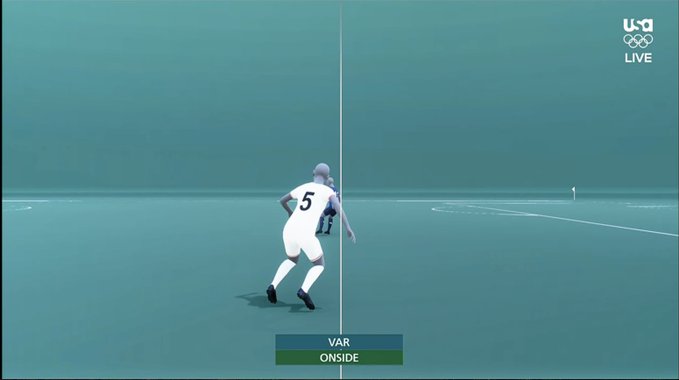
Source: The Women’s Game (Men in Blazers) x.com post
From that view, it appears that the shoulder area of Rodman (#5) was the closest relevant body part to Japan’s goal-line at the time Dunn kicked the ball. As the whole shoulder appears to be at least a couple inches behind the offside line, this simplifies the argument against an offside call because one does not need to delve into the intricacies of the “armpit” rule for determining where an arm begins. The next closest body part looks to be Rodman’s right knee, as she was on her toes and leaning forward beyond her toes.
The SAOT animations also included individual views of Rodman and Kitagawa (#13), showing their body positions, including the body part that kept Rodman online. On Instagram, ESPN Deportes posted cropped graphics of these individual views:
Thus, it appears that one of (#13) Kitagawa’s buttocks, which is the body part ‘touching’ the offside line’s hypothetical vertical wall, kept Rodman online.
So, what happened behind the scenes?
From the time that Trinity Rodman’s goal crossed the goal line to the restart by Japan, about 80 seconds elapsed. The actual discussions between the center referee and her on-field assistants, as well as with the VAR crew likely took no more than about a minute, if that.
Note that during the broadcast, there was no obvious video of the center referee, Tess Olofsson, discussing the play using her wireless communications system, nor did she head to a video review monitor. So, officially, there was no VAR-assisted review of the goal-scoring play.
The VAR crew would have been watching the play in real time on their monitors and, during the USWNT celebration and unofficial water break before the restart, almost certainly reviewed both the potential offside as well as a potential handball by Rodman (discussed in more detail below).
From a procedural perspective, what did probably happen was that the video assistant referee did not recommend a review, which is the most that they could have done, since they do not have a “veto” over a center referee’s decisions. As the on-field decisions were no offside offense, no handball offense, and a good goal, the burden of proof for overturning the decision was effectively higher, due to the “clear and obvious error” and “clear missed incident” standards.
Depending on how advance the SAOT system’s automated alert system, it may have ignored Horan’s movements, and reported a “close onside” situation by the time that Oloffson pointed to the center circle. Rodman received the ball at the 1:06 mark of added time, while the goal crossed the goal-line about five seconds later. Even if the SAOT considered Horan to be the offside player, the VAR crew could have quickly used the SAOT software and selected Rodman as the relevant player. So, the non-call for an offside was likely confirmed within 20 seconds, if not faster.
The potential handball was also likely analyzed relatively quickly as the broadcast video angles are relatively clear in showing that the ball did not touch Rodman’s right arm.
(For examples of how VAR crews handle review situations, see the “Inside Video Reviews” posted by the Professional Referee Organization, aka “PRO”, on YouTube. There are playlists for matches involving the NWSL as well as MLS. The videos include actual audio of VAR crews and the center referees.)
One more thing…
An additional issue that could have seen the goal called back was a potential handball situation as Rodman attempted to collect the ball: The ball bounced and hit her right upper chest area, coming very close to touching her upper arm area. However, the video replay shows fairly conclusively that it did not hit her upper arm. Compared to the pitch-level camera from behind the right half of the goal-line, the elevated sideline camera (starting at about the 0:37 mark in the Telmundo Deportes highlight video, above), has the better view. From that perspective, one can see Rodman intentionally moving her lower right arm away from the ball and her upper right arm closer to her torso
Though even if the ball did touch Rodman’s arm, there is a possibility that it would not be a handball offense, as Law 12 (IFAB) has exceptions for non-deliberate touches and natural body movements. In any case, a handball offense was not signaled and the goal stood, so presumably a non-call was not deemed a “clear and obvious error” or a “clear missed incident”.
 Women's Soccer Express