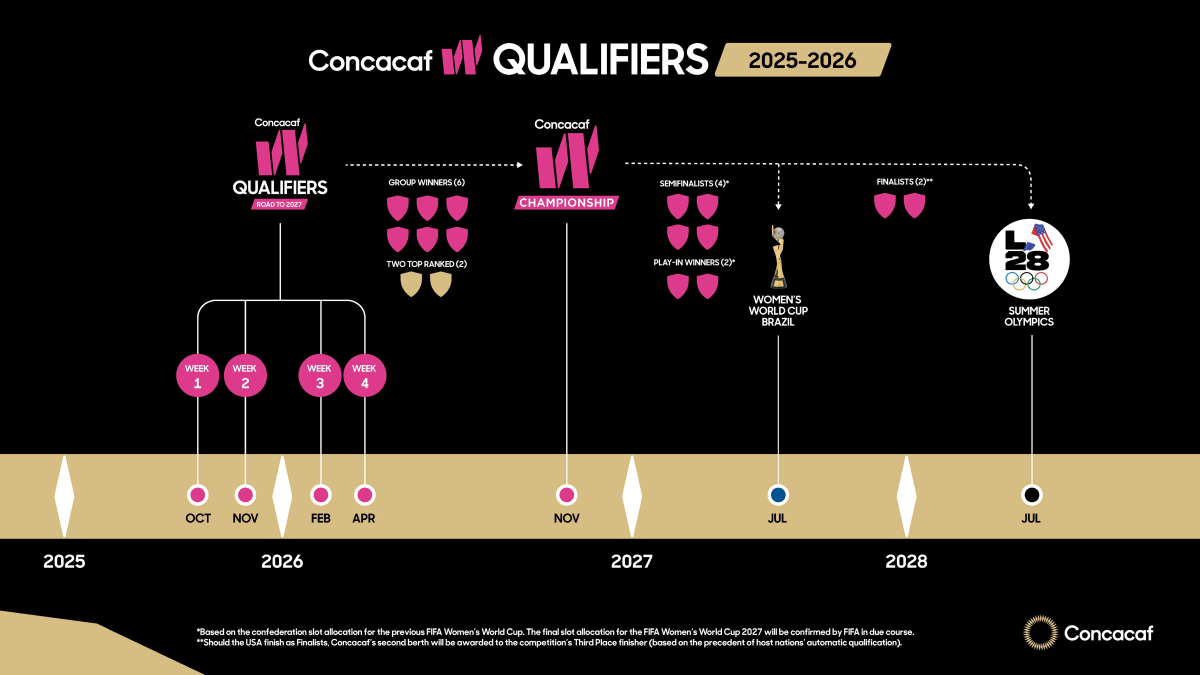

In mid-September, Concacaf published their plans for how women’s national teams in the region will qualify for the next FIFA Women’s World Cup and Summer Olympics. Instead of a traditional tournament with round-robin groups and a knockout phase, the final phase of qualifying will consist only of a knockout competition for the eight qualified teams. The four losing teams from the opening quarterfinals will then compete for Concacaf’s play-in spot(s).
The format change means that for the final eight teams, just one game will decide whether each gets an automatic slot into the 2027 FIFA Women’s World Cup, which will be hosted by Brazil. A single loss in the quarterfinal stage also means elimination from qualifying for the 2028 Los Angeles Olympics.
The two highest-ranked teams in Concacaf, which will almost certainly be the United States and Canada, will have direct entry to the quarterfinal stage, so those two teams will only need to win a single match in order to qualify for the 2027 WWC. This is ridiculously lower than the minimum number of matches that the highest-ranked teams in Concacaf have traditionally been required to play. It is also embarrassingly lower than the number of qualifying matches that top teams in other confederations are required to play in order to earn a WWC slot.
Additionally, the simplified format reduces the likelihood that the best teams from Concacaf will qualify for the next WWC and Olympics. Although a loss in the quarterfinals does not eliminate a team from qualifying for the WWC, the best team(s) from the repechage have the additional burden of competing in an inter-confederation play-in tournament, which could see them face competitive teams from Europe and Asia.
The New Reality
According to Concacaf’s press release, intra-confederation qualifying for the 2027 FIFA Women’s World Cup will begin in October 2025 with a preliminary round and conclude in November 2026 with the Concacaf W Championship.
Phase One: 2025-26 Concacaf W Qualifiers
The preliminary round will have the same format as it did last cycle:
- The two highest-ranked national teams will enter qualifying at the final knockout bracket stage. For this determination, Concacaf’s WNT rankings will be used.
- The remaining teams will be divided into six groups of five teams.
- Those six groups will play a single round-robin format, with each team having two home matches and two away matches.
- Only the top team from each group will advance to the main qualifying tournament.
The Top Two Teams
Based on Concacaf’s rankings, the top two teams receiving byes to the qualifying tournament will be the United States (6,642 points) and Canada (4,929 points).
Possible Play-In Round
Although not explicitly stated in the press release, should more than 32 teams in Concacaf attempt to qualify for the WWC, a play-in stage would be held, so that no group has more than five teams. This was mentioned in the December 2020 press release for last cycle’s competitions (concacaf.com).
Such a play-in stage would be contested among the lowest-ranked teams to determine the final slots. For example, if 33 teams enter, then the two lowest teams would play each other. Should 34 teams enter, the third-lowest team would likely play the winner of a match between the two lowest teams.
Concacaf currently has 41 member associations (Wikipedia), but only 31 are eligible for both the FIFA WWC and the Summer Olympics as those 31 associations are members of both FIFA and the International Olympic Committee. Four additional associations are members of FIFA but not the IOC. The remaining six associations, which represent overseas jurisdictions of France and the Netherlands, are not members of FIFA, nor are they members of the IOC, so they are not eligible for either competition.
Last cycle, exactly 32 women’s national teams participated in qualifying, so no play-in was required (Wikipedia).
The Group Stage
Before the preliminary round kicks off, a draw will be held to divide the teams into the six groups of five teams. The press release does not specify whether Concacaf will use its own ranking system or the FIFA Women’s World Ranking. Last cycle, FIFA’s rankings were used.
Based on current rankings, if FIFA’s system is used, then the six best teams — after the USA and Canada — would be Mexico, Jamaica, Costa Rica, Haiti, Panama and Trinidad & Tobago. These same six teams were in Pot 1 for last cycle’s draw, though their specific ranking order was different. Each of these teams won their group and advanced to the qualifying tournament phase.
However, if Concacaf’s system is used, Trinidad & Tobago would be bumped to Pot 2 and El Salvador would be the lowest-ranked team in Pot 1. (Also, the overall ranking order of the other teams in Pot 1 would be different.)
Depending on the overall draw, one or more of the teams outside of Pot 1 could have a decent chance to claim the only ticket out of their group. Of the lower-ranked teams, the most likely spoiler would be Puerto Rico, which has made significant improvements in recent years: Their youth WNTs are currently ranked 7th in Concacaf’s U-20 WNT rankings and 6th in its U-17 WNT rankings. Last cycle, Puerto Rico finished second in its group, only losing to Mexico.
Match Calendar
Unlike last cycle, a team’s four matches will be played out over four international windows, with just one qualifying match per window. Previously, the four matches were played over two international windows.
This should allow national teams to play a friendly (or two, depending on the window), ideally as a tune-up before each qualifier. At least some of the smaller associations will likely not schedule friendlies during these windows due to costs and/or logistics.
The actual dates of the four international windows are as follows:
- October 20 to 29, 2025
- November 24 to December 2, 2025
- February 24 to March 7, 2025
- April 7 to 18, 2025
Sources:
- FIFA – Women’s International Match Calendar 2024-2025 (PDF)
- FIFA – Women’s International Match Calendar 2026-2029 (PDF)
Phase Two: The 2026 Concacaf W Championship
In November and December 2026, an eight-team tournament, the Concacaf W Championship, will be held. The two highest-ranking teams in Concacaf will be joined by the six group winners from the Concacaf W Qualifiers.
The tournament is scheduled for the last international window of 2026, which begins on November 24th and ends on December 5th. This window is classified as a “Type II”, which means that up to three international matches are allowed.
The official slot allocations per confederation for the 2027 WWC are not confirmed, but based on the 2023 WWC, Concacaf should have four automatic spots and two inter-confederation play-off spots. For the 2028 Summer Olympics, the USA should automatically qualify as host and Concacaf should have two additional spots.
Competition Format
The Concacaf W Championship will consist of a primary tournament, with a quarterfinals round, a semifinals round, a third-place match, and a final.
The Quarterfinals
For the quarterfinal match-ups, “Concacaf will rank teams 1-8, with the highest-ranked team facing the lowest-ranked team” (direct quote from the press release). Unfortunately, the press release does not clearly state how the remaining six teams would be seeded. The most likely format would be an NCAA-style bracket, so the quarterfinal matches would be as follows:
- #1 vs. #8
- #4 vs. #5
- #2 vs. #7
- #3 vs. #6
Under an NCAA-style bracket, the winners of the first two matches would then play in one semifinal, while the winners of the other two matches would play in the other semifinal.
As to what system Concacaf would use to rank the quarterfinal teams, the press release does not specify. Concacaf could use its own WNT ranking system, FIFA’s WNT rankings, or, less likely, the system it used for ranking teams after the group stage of the 2024 Concacaf W Gold Cup, where teams were ranked based on their group performance.
The four teams that advance from the quarterfinals will qualify for the 2027 FIFA Women’s World Cup in Brazil, assuming Concacaf’s slot allocation remains the same as it was for the 2023 WWC.
The Semifinals and Placement Matches
The four teams that advance from the quarterfinals will also play two additional matches: A semifinal and a placement match. Those matches will be used to determine which teams also earn one of Concacaf’s berths to the 2028 Summer Olympics.
Typically, the top two teams — i.e., the teams that reach the final — qualify for the Summer Olympics. However, as the USA is participating in the Concacaf W Championship and is expected to automatically qualify as the host country of the 2028 Summer Olympics, if the USA advances to the final, then the third-place match will be used to determine the second team that qualifies for the Olympics.
Unless there is a change in Concacaf’s slot allocation for the 2028 Summer Olympics, then the only thing at stakes in the final will be bragging rights.
A Second Chance
The four teams that do not advance from the quarterfinals can still qualify for the 2027 WWC but not the 2028 Summer Olympics.
According to Concacaf’s press release, those four teams will then compete in a “Play-In” round for the confederation’s “two remaining slots in the Women’s World Cup”. However, if the same allocation is used as the 2023 WWC, then those two slots would be for an inter-confederation play-in tournament. (In 2023, Concacaf had two play-in slots, which were filled by Haiti and Panama. Each of those teams won their play-in pods, so Concacaf had a total of six teams.)
The possible format(s) of the play-in round have not yet been specified.
If Concacaf has two inter-confederation play-in spots, then the non-advancing teams from the quarterfinals would likely be paired off, with the winners of each match-up earning one of the two slots.
Hypotheticals
To help illustrate Concacaf’s new qualifying format for the 2027 WWC and 2028 Summer Olympics, here are two possible scenarios, which differ only by the ranking system which is used. The first scenario uses Concacaf’s WNT Rankings, while the second scenario uses the FIFA Women’s World Ranking. Both scenarios presume that the six women’s national teams ranked third through eighth win each of their respective groups. Additionally, both scenarios presume that a fully-seeded NCAA-style quarterfinals bracket is used.
Here are the top eight teams from Concacaf under each ranking standard:
Current Concacaf WNT Rankings (source, official explanation*)
- USA (6,642 points)
- Canada (4,929 points)
- Costa Rica (3,704 points)
- Mexico (3,342 points)
- Jamaica (3,177 points)
- Panama (2,351 points)
- Haiti (2,172 points)
- El Salvador (1,754)
*When Concacaf released the WNT rankings, their press release did not include an explanation of the ranking procedures. The above link is for the MNT ranking system, which is presumed to be substantially similar, if not identical to the WNT ranking system.
Current FIFA WNT Rankings (source, official explanation)
- USA (2076.90 points, #1 overall)
- Canada (1982.24 points, #6 overall)
- Mexico (1669.70 points, #30 overall)
- Jamaica (1542.29 points, #42 overall)
- Costa Rica (1540.71 points, #43 overall)
- Haiti (1481.87 points, #53 overall)
- Panama (1422.68 points, #60 overall)
- Trinidad & Tobago (1294.31 points, #77 overall)
One key difference between the two ranking systems is that Concacaf assigns more weight (e.g., a larger multiplier) to matches played in the last four years, compared to older matches. The systems also have different “Match Importance” scales, though, as Concacaf’s ranking procedures are not publicly available, specific comparisons are impossible.
Scenario One – Concacaf (Luckily, the USA is hosting the Olympics)

If Concacaf’s WNT rankings are used, then the quarterfinal match-ups would be as follows:
- (1) USA vs. (8) El Salvador
- (4) Mexico vs. (5) Jamaica
- (2) Canada vs. (7) Haiti
- (3) Costa Rica vs. (6) Panama
Assuming no upsets, then the semifinal match-ups would be USA vs. Mexico and Canada vs. Costa Rica. Oh, and for this hypothetical, let us assume that Mexico is hosting. So, the USA could have to play a resurgent Mexico WNT in Mexico, after a long NWSL season. But, luckily for the USA, they should automatically qualify as host of the 2028 Summer Olympics, so the semifinal will not be a “must win” match for the USA.
Regarding potential upsets, the only match result that looks to be certain would be the USA defeating El Salvador. All of the remaining top four teams would be favored in their quarterfinals, though their opponents all have the potential to win their matches. Unfortunately, a significant portion of that potential will depend on how much support those WNTs receive from their national associations.
The two play-in match-ups would see Jamaica play El Salvador and Haiti face Panama. Jamaica should win its match, but the other match is a bit of a toss-up that leans toward Haiti.
Scenario Two – FIFA (Canada and Mexico Root for the USA)
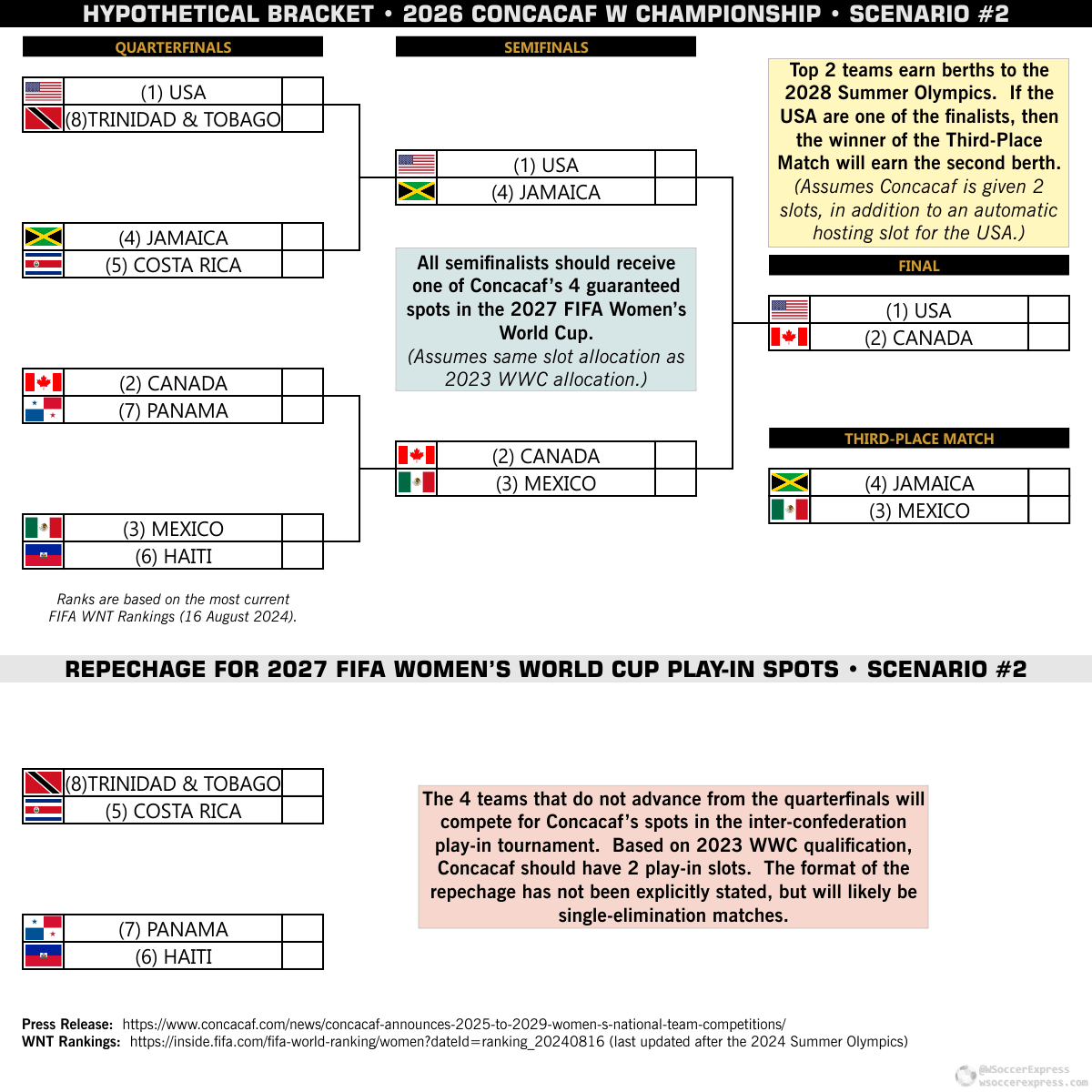
Using FIFA’s rankings system, the top three teams are the traditional powers: (1) USA, (2) Canada, and (3) Mexico. The fourth-ranked team would be Jamaica, but Costa Rica is less than two points (1.58, to be exact) behind, so those teams could easily flip spots. Meanwhile, Haiti and Panama remain in the bottom half of the bracket, but switch places. The final team would be Trinidad & Tobago.
Thus, the quarterfinal pairings would be the following:
- (1) USA vs. (8) Trinidad and Tobago
- (4) Jamaica vs. (5) Costa Rica
- (2) Canada vs. (7) Panama
- (3) Mexico vs. (6) Haiti
If the higher-ranked team wins each quarterfinal, the semifinal match-ups would be USA vs. Jamaica and Canada vs. Mexico.
Unless Jamaica upsets the USA, the loser of the Canada-Mexico semifinal would have a second opportunity to qualify for the Olympics, so going into their semifinal, both teams would want the USA to win the other semifinal.
However, an upset by Jamaica would be fairly unlikely as would Panama upsetting Canada. The only match with a decent chance of an upset would be Mexico-Haiti, while the #4 vs. #5 match between Jamaica and Costa Rica would be a toss-up.
One of the expected play-in matches would be the same as under Concacaf’s rankings: Panama vs. Haiti, though, here, Haiti would be the higher-ranked team. For the other play-in match, Trinidad & Tobago would face Costa Rica.
Post-WWC Phases
In addition to qualifying for the FIFA Women’s World Cup and the 2028 Summer Olympics, Concacaf’s press release also includes confirmation of a Concacaf W Nations League for the calendar year 2028, which will be used to qualify teams for the 2029 Concacaf W Gold Cup.
2028: Concacaf W Nations League
This will be the “inaugural edition” of a women’s Nations League in Concacaf. The group stage will be contested in February and April. The finals of the Nation League will be held in November. No additional details are available.
2029: Concacaf W Gold Cup
The second edition of the Concacaf W Gold Cup is scheduled to “take place in the summer of 2029”. No further details are available.
Reality Checks
This would not be the first time that Concacaf has used a bracket-only format for the final tournament of WWC qualifying. However, the announced format stands out like a sore thumb compared to the qualifying formats used by the other confederations.
Comparison of Qualifying Formats used by Concacaf during Past Cycles
In eight of the nine previous FIFA Women’s World Cup qualifying cycles, Concacaf has used a group stage in the final tournament:
- 1991: Two groups of four, semifinals, third-place match, final – Only the winner of the final qualified
- 1995: A single group of five – Top two teams qualified
- 1999: Two groups of four, semifinals, third-place match, final – Winner of the final qualified, the runner-up advanced to an inter-confederation play-off (USA, as WWC host, did not participate)
- 2003: Two groups of four, semifinals, third-place match, final – Semifinals winners qualified, third-place team advanced to an inter-confederation play-off
- 2007: Modified six-team bracket with quasi-quarterfinals, semifinals, third-place match, final – Semifinals winners qualified, third-place team advanced to an inter-confederation play-off
- 2011: Same format as 2003
- 2015: Two groups of four, semifinals, third-place match, final – Semifinals winners and the third-place team qualified, the fourth-place team advanced to an inter-confederation play-off (Canada, as WWC host, did not participate)
- 2019: same format as 2015
- 2023: Two groups of four, semifinals, third-place match, final – Top two teams from each group qualified, third-place teams from each group advanced to the inter-confederation play-off tournament
(The above hyperlinked years go to the Wikipedia pages for Concacaf’s qualification tournament for each WWC cycle.)
The lone exception was the 2007 cycle (bolded above), which used a modified six-team bracket where the USA and Canada, as the two highest-ranked teams, received byes to the semifinals. Those semifinals were used to decide who would qualify directly for the WWC. The losers of the semifinals then competed in a third-place match for Concacaf’s lone inter-confederation play-off spot.
With the expansion of the FIFA Women’s World Cup to 32 teams, Concacaf’s announced format for qualifying to the 2027 WWC essentially parallels the 2007 cycle’s format, especially for the two highest-ranked teams: As in 2006, the USA and Canada will only need to win a single match in order to directly qualify.
Starting with the 1999 cycle, the top two or three teams received byes to the final tournament and thus did not have to go through any preliminary qualifying round(s).
Inter-Confederation Comparisons: The 2023 WWC Cycle
For the qualifying cycle of the last FIFA Women’s World Cup, five of the six confederations used a final tournament to decide which teams would qualify for the WWC. Only two of those confederations, the AFC and Concacaf, allowed their top teams to directly enter the final tournament. For Concacaf, the two highest-ranked teams, USA and Canada, received byes to the group stage of the 2022 Concacaf W Championship and only needed to play three group stage matches to qualify for the WWC.
In Asia, the top three teams from the previous AFC Women’s Asian Cup received byes to the quarterfinals of the 2022 edition. Those teams only needed to play three group stage matches plus a quarterfinal match.
The two smallest confederations, CONMEBOL (10 members) and the OFC (13 members), did not have any preliminary qualifying stages and only had a final tournament. In those confederations, a team could qualify after playing five matches.
For the 2022 Women’s Africa Cup of Nations, except for the host, Morocco, all teams needed to play two preliminary rounds of home-and-way qualifiers in order to qualify for the 12-team final tournament. Then, teams needed to advance from a three-match group stage and win a quarterfinal to earn a direct spot in the 2023 WWC.
During the last cycle, UEFA was the only confederation to use a non-tournament format. For the first stage, teams were drawn into groups of five or six teams and played a home-and-away round-robin group stage. The winner of each group qualified directly for the 2023 WWC, thus a team needed to play a minimum of 8 or 10 matches. Meanwhile, the runners-up in each group moved to a play-off stage where they competed for UEFA’s final two direct slots, plus one inter-confederation play-off spot.
The following is a summary of the minimum number of qualifying matches that a team (e.g., the highest-ranked team) had to play in each confederation in order to directly qualify for the 2023 WWC:
- UEFA: 8 or 10 matches (8 or 10 group matches)
- CAF: 8 matches (2 rounds of home-and-away, 3 group matches, quarterfinal)
- OFC: 5 matches (2 group matches, quarterfinal, semifinal, final)
- CONMEBOL: 5 matches (4 group matches, semifinal)
- AFC: 4 matches (3 group matches, quarterfinal)
- CONCACAF: 3 matches (3 group matches)
(The above hyperlinks go to the Wikipedia page that summarizes each confederation’s qualification tournament for the 2023 cycle.)
For the formats where a group stage was the earliest that a team could qualify, some teams clinched a spot in the WWC before playing all group matches, so their actual number of required matches was lower than those stated above.
It is worth noting that the AFC will be moving to a more comprehensive WWC qualifying format beginning with the 2031 cycle (the-afc.com press release). The top teams will receive byes to an intermediate group stage and will need to play a minimum of nine matches (3 group matches in the intermediate stage, then 6 group matches in the final home-and-away group stage).
Concacaf’s announced qualifying format for the 2027 cycle is notably similar to CAF’s format for the 2022 Women’s Africa Cup of Nations, with the importance exceptions that the CAF tournament had a group stage: The quarterfinals determined which four teams would directly qualify for the 2023 WWC. The teams that lost their quarterfinal matches were then paired and played one-off repechage matches, with the winners of those matches advancing to the inter-confederation play-off tournament.
Similarly, for the 2022 AFC Women’s Asian Cup, the earliest a team could qualify was the quarterfinals stage. However, Asia had 5 slots, so at least one* loser of the quarterfinals could qualify directly during the intra-confederation repechage phase. Two other quarterfinal losers could qualify for the inter-confederation play-off tournament. *Australia, who were a co-host of the 2023 WWC, participated in the 2022 Asian Cup. They lost their quarterfinal to the Korea Republic, which meant only one direct slot was available during the repechage phase.
The Other Side: Men’s World Cup Qualifying in Concacaf
On the men’s side, since the expansion to a 32-team World Cup after the 1994 cycle, qualifying inside Concacaf has always involved a significant number of matches, even for the confederation’s highest-ranked teams.
Glory Days: The Hex Era
In the 32-team era of the men’s World Cup (1998 to 2022), except for the last cycle, qualifying inside Concacaf ended with a six-team home-and-away group stage that was known as the “Hex”, which was a shortening of the word “hexagonal”.
During the Hex era, a minimum of at least three top teams received byes to a later round. In four of the six cycles, the top teams entered qualifying in the stage that immediately preceded the Hex. That stage consisted of four-team groups, where each team played the teams in its group twice, home and away. For the other two cycles, the top teams entered a stage earlier and played a home-and-away round against a significantly lower-ranked opponent.
Thus, a top men’s team in Concacaf would have to play either 16 or 18 qualifying matches during a men’s World Cup cycle.
2022: What Was and What Could Have Been
In 2022, the final qualifying stage of men’s World Cup qualifying in Concacaf ended up being an eight-team home-and-away “octagonal” with the top five teams in the region receiving byes directly to this final round. So, a top team had to play 14 matches.
Under Concacaf’s original qualifying format for the 2022 men’s World Cup (Concacaf press release), the top six teams, based on the FIFA men’s national team rankings, would have been placed directly in a Hex, which would have been the only way to directly qualify for the 2022 men’s World Cup from Concacaf. In that hexagonal, the three teams that finished at the top of the group would earn a direct slot, while the fourth-place team would play the winner of a separate Concacaf competition for an inter-confederation play-off spot.
This separate competition, which would have involved the other 29 eligible national teams, would have consisted of a home-and-away group stage with eight groups, followed by a knockout bracket using a home-and-away format. Only the winners of each group would have advanced to the knockout stage.
The original format would have disadvantaged the men’s national teams that ended up ranked just outside the top six, as it would have removed any path of direct qualification for those teams. Meanwhile, lower-ranked teams, which would normally be eliminated before the Hex, would have had an outside chance of qualifying for the men’s World Cup.
2026: Concacaf tries something different
For the current cycle (Wikipedia), the United States, Mexico, and Canada, as hosts of the 48-team 2026 men’s World Cup, are not involved in Concacaf qualifying. The remaining top teams received byes to the second of three stages. The second stage consists of six five-team single round-robin groups, with the top two teams advancing to a final round of three four-team home-and-away round-robin groups. Only the top team in each group earns a direct slot to the men’s World Cup. The best two second-place teams advance to the inter-confederation play-offs.
Summary
The following list shows the number of qualifying matches that one of the highest-ranked men’s teams in Concacaf (e.g., the USMNT) had or has to play each cycle in order to directly qualify for a men’s World Cup:
- 1998: 16 matches (6 group, 10 Hex)
- 2002: 16 matches (6 group, 10 Hex)
- 2006: 18 matches (2 home-and-away, 6 group, 10 Hex)
- 2010: 18 matches (2 home-and-away, 6 group, 10 Hex)
- 2014: 16 matches (6 group, 10 Hex)
- 2018: 16 matches (6 group, 10 Hex)
- 2022: 14 matches (14 Octagonal)
- 2026: 10 matches (4 group, 6 group)
(The above hyperlinked years go to the Wikipedia pages for Concacaf’s qualification tournament for each men’s WC cycle.)
Alternative Realities
The following is one perspective of what an ideal qualifying format in Concacaf could look like. It is not super-detailed, as it does not discuss specific international windows, nor does it discuss costs for Concacaf and its member associations, which depending on their financial situations and interest in women’s soccer, may make some facets of the proposal untenable.
Basic Principles
Qualifying formats in international soccer are a balance of multiple interests. Primarily, those interests fall into three categories: Sporting, financial, and political. Additional concerns include logistics and player health.
Another factor impacting qualifying formats for international women’s soccer is a difference in the level of enthusiasm for women’s soccer, compared to men’s soccer, at the institutional level.
Regarding the number of required matches, that depends on both the number of teams participating and the number of spots available. The number of spots available tends to decrease the number of required matches, while the number of teams participating tends to increase the number of matches that are required.
From a fairness perspective, allowing teams to bypass significant qualifying stages should be avoided. However, giving some teams a bye is often necessary as it can be used to eliminate unbalanced formats and/or the need for awkward formats.
Peeking Ahead
Currently, the 2027 FIFA Women’s World Cup is set to have a 32-team field, but there is a possibility that as early as 2031, the WWC could be expanded to 48 teams, which should mean additional spots for Concacaf.
Also, for future cycles, the introduction of a women’s “Nations League” competition in Concacaf reduces the need for a completely separate Women’s World Cup qualifying competition because the most recent Nations League cycle can be used as a preliminary round for sorting all teams.
Geometric Symmetry: A Hexagonal or Octagonal
In years past, some fans and journalists (x.com, ESPN.com) have called for a WWC qualifying format similar to the men’s, namely having a final round Hex. Such a format would require the highest-ranked teams in Concacaf, i.e., the USA and Canada, to play a minimum of ten matches, half of which would be away matches.
While a final qualifying round consisting of a Hex or octagonal could be considered an ideal format — as (1) it requires a significant number of qualifying matches, even for the top teams; (2) it does not give any team a net home field advantage; (3) it is similar to UEFA’s qualifying format, which could be considered the de facto standard; and (4) it can be used to locally promote women’s soccer in each Hex team’s country — for political and developmental reasons, such a format can no longer be considered the best option.
Under a traditional Hex format, only six teams participate in the final five or so international windows of World Cup qualifying. Increasing the number of teams that are still ‘in the hunt’ during the final rounds guarantees that more national teams in Concacaf stay active and play competitive matches, which is good for the development of women’s soccer in the region. Also, an increase in the number of teams participating in the final stages is generally more politically appealing*, as it means that more national associations have non-zero chances of qualifying for a Women’s World Cup, and improves the reputation of the participating national associations. However, participation would introduce additional costs, which depending on the financial situation of a national association as well as the institutional enthusiasm for women’s soccer in the national association, could lead some members of Concacaf to be unsupportive of qualifying format that increase the number of required matches for lower-ranked teams.**
The best example of politics affecting a qualifying format in Concacaf is the original plan for the 2022 qualifying cycle of the men’s World Cup (summarized above), which gave one successful lower-ranked team the chance to compete for a play-in spot, while the national associations with the largest media markets, the USA and Mexico, would have had direct entry into a Hex where three direct slots to the men’s World Cup were available.
*In Concacaf, 31 of the 41 members associations belong to the Caribbean Football Union. Those 31 associations represent the largest voting bloc in Concacaf. The other 10 members are divided between Central America, which consists of 7 members, and the trio of large continental countries: USA, Mexico, and Canada.
**Financial and institutional support for women’s national teams is still a significant issue affecting many national associations within Concacaf. For glaring examples, see Jamaica recently (Pro Soccer Wire) and Trinidad & Tobago back in 2014 (The Guardian UK).
A More Realistic Option: Double Quads with a Parallel Repechage
Instead of a home-and-away hexagonal or octagonal, one less involved alternative for the final qualifying stage would only require a pair of three-match international windows and would limit travel between matches.
Additionally, the qualifying format should have a repechage for the best tier of teams teams outside the final qualifying stage because it would be good both for sporting reasons as well as the development and promotion of women’s soccer inside Concacaf and its member associations.
The Proposal
The following assumes that (1) 32 women’s national teams enter qualifying, (2) Concacaf has four direct entry slots for the WWC, (3) Concacaf has two inter-confederation play-in spots for the WWC, and (4) Concacaf has two berths for the Summer Olympics.
Summary:
- Byes: The top four teams in Concacaf receive byes to the Primary Group Stage. For the current cycle, the ranking should be based on the Concacaf rankings. For future cycles, the byes should go to the best four teams from the most recent Concacaf Nations League cycle.
- Preliminary Stage: The bottom eight teams are reduced to four teams either by pairing those teams into home-and-away match-ups or by drawing them into two groups of four teams that play a single round-robin format at centralized locations. (Teams in this stage play either 2 or 3 matches.)
- First Group Stage: The best twenty teams (excluding the four that received byes) plus the four teams that advanced from the Preliminary Stage are placed into four groups of six. These groups play a home-and-away round-robin. Only the top team from each group advances to the Primary Group Stage. (Teams in this stage play 10 matches.)
- Double Quads Stage: The four teams that received byes to this round are joined by the four group winners from the First Group Stage. Those eight teams are drawn into two groups of four. Inside the groups, each team will play the other teams twice. However, the top two teams in each group — i.e., both of the teams that received a bye — will each host one set of three matches. The top two teams in each group will qualify for the 2027 WWC and advance to a later play-off for Concacaf’s slots in the 2028 Summer Olympics. The third-place teams in each group will advance to the Play-Off Stage. The top two teams from each group would also advance to the Olympics Play-Off. (Teams in this stage play 6 matches.)
- Repechage Stage: From the First Group Stage, the eight teams that finished second and third in their groups are drawn into two groups of four. The winners of these groups advance to the Play-Off Stage. Regarding the format for this stage, all teams should play their opponents twice. Either a traditional home-and-away format or the centralized hosting format of the Double Quads Stage could be used. (Teams in this stage play 6 matches.)
- Play-Off Stage: Each of the two third-place teams from the Double Quads Stage will be paired with a Repechage Stage winner. Those teams will play home-and-away style, with the winners of each match-up claiming one of Concacaf’s play-in spots. (Teams in this stage play 2 matches.)
- Olympics Play-Off: This competition should be played after the 2027 WWC and before the draw for the Olympic tournament. (E.g., the February 2028 international window.) The play-off should consist of a pair of home-and-away match-ups based on the FIFA rankings. E.g, #1 in Concacaf vs. #4 Concacaf and #2 vs. #3. (Special Rule for 2028: Should the USA be one of the top four teams, then the third-place team in their group would earn the final spot. Alternatively, the two third-place teams could play each other for the final spot.)
Discussion
By using the above format, sixteen teams would be active during the late stages of the qualifying, instead of just half or less under a Hex format or a traditional final tournament.
Twelve of those teams would play a minimum of sixteen matches during WWC qualifying, while the best four teams, which received byes, would play at least six matches. This would put Concacaf in the middle of the pack when it comes to the minimum number of matches for a top team. Also, six matches is the same minimum number of matches that a men’s team in UEFA will need to play in order to qualify directly for the 2026 World Cup (Wikipedia).
Giving the top four teams from the previous Nations League cycle a bye to the Double Quads Stage gives team more to play for than just a slot in the Concacaf W Gold Cup. It also helps to make the First Group Stage more manageable. Additionally, knowing which two teams will host the matches in each group is good for planning and promotional reasons: As the four hosts will know their status at least a year or two in advance, the stadiums that will be used can be reserved well in advance. It also means that the match times can be set months ahead, which increases the likelihood that the qualifying matches will air at ideal times for the best TV broadcast windows.
Having the top two teams in each group of the Double Quads Stage host approximates a home-and-away structure while being simpler logistically, both for the national teams involved as well as Concacaf. Also, hosting these matches could provide a financial reward for the the best four teams, as they would keep most of the gross ticket revenues from the matches that they host. (Typically, for Concacaf competitions, 5% of the gross ticket revenue is paid to Concacaf.)
Adding a repechage stage counter-balances the harshness of only allowing the top team from each group of the First Stage to advance as, instead of being eliminated, a team that narrowly finished as a runner-up in one of those groups now has a second chance through an alternative qualifying path.
To help improve the lowest-ranked teams not involved in the Repechage Stage, Concacaf could host four-team developmental tournaments during some of the three-match international windows.
Should the Women’s World Cup be expanded to 48-teams, which would likely mean six direct slots for Concacaf, the same proposed format could be used, except that the top three teams in each group of the Double Quads Stage would earn one of the direct slots, and the fourth-place teams would then compete in the Play-Off Stage against the Repechage Stage winners. Alternatively, if feasible, the Double Quads Stage could be expanded to Triple Quads, with the top two teams in each group qualifying directly for the WWC. If three groups of four are used, then a parallel repechage would not be used.
 Women's Soccer Express