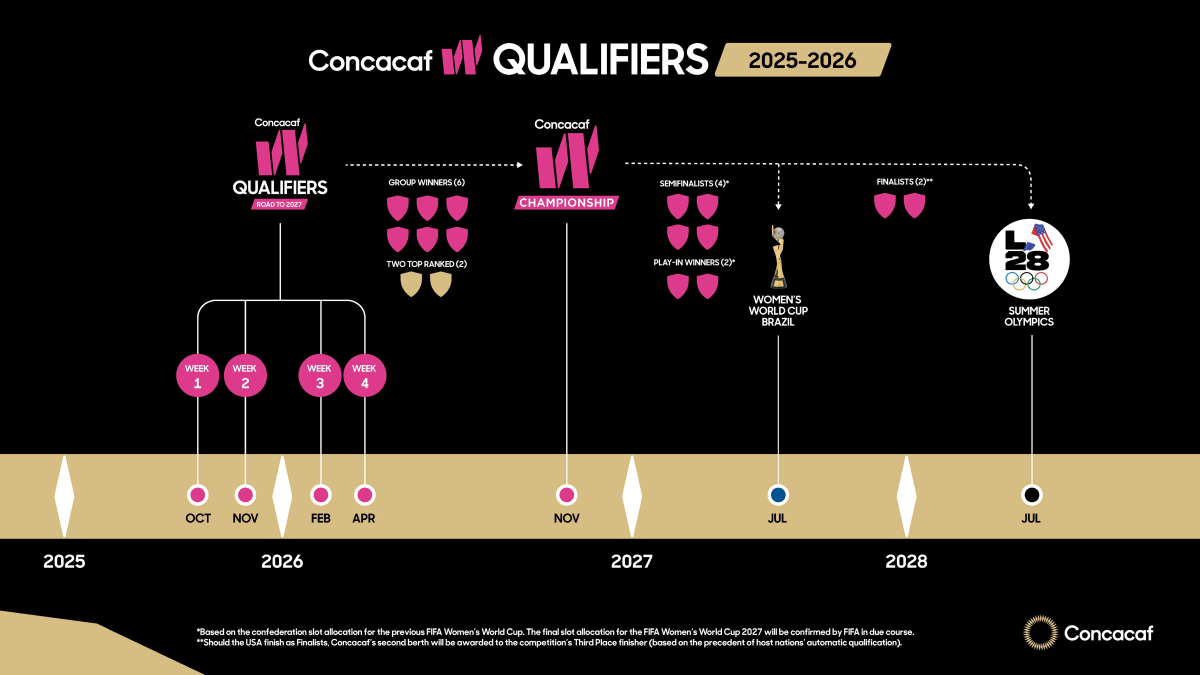

In mid-September, Concacaf published their plans for how women’s national teams in the region will qualify for the next FIFA Women’s World Cup and Summer Olympics. Instead of a traditional tournament with round-robin groups and a knockout phase, the final phase of qualifying will consist only of a knockout competition for the eight qualified teams. The four losing teams from the opening quarterfinals will then compete for Concacaf’s play-in spot(s).
The format change means that for the final eight teams, just one game will decide whether each gets an automatic slot into the 2027 FIFA Women’s World Cup, which will be hosted by Brazil. A single loss in the quarterfinal stage also means elimination from qualifying for the 2028 Los Angeles Olympics.
The two highest-ranked teams in Concacaf, which will almost certainly be the United States and Canada, will have direct entry to the quarterfinal stage, so those two teams will only need to win a single match in order to qualify for the 2027 WWC. This is ridiculously lower than the minimum number of matches that the highest-ranked teams in Concacaf have traditionally been required to play. It is also embarrassingly lower than the number of qualifying matches that top teams in other confederations are required to play in order to earn a WWC slot.
Additionally, the simplified format reduces the likelihood that the best teams from Concacaf will qualify for the next WWC and Olympics. Although a loss in the quarterfinals does not eliminate a team from qualifying for the WWC, the best team(s) from the repechage have the additional burden of competing in an inter-confederation play-in tournament, which could see them face competitive teams from Europe and Asia.
Continue reading “Concacaf takes step backward with qualifying format for the 2027 Women’s World Cup and 2028 Olympics”

 Women's Soccer Express