
On November 19th, in a joint press conference with U.S. Soccer, Michele Kang, majority owner of the NWSL’s Washington Spirit, announced that she has pledged to give a total of $30 million over the next five years to U.S. Soccer. Kang’s pledged gift has three stated purposes:
- First, to double the number of youth women’s national team camps.
- Second, to ramp up women’s youth talent identification by expanding U.S. Soccer’s digital talent identification platform.
- Third, to double the number of licensed female coaches and female referees.
Beyond the stated purposes of the pledged gift, there were not much details about how the $30 million will be spent.
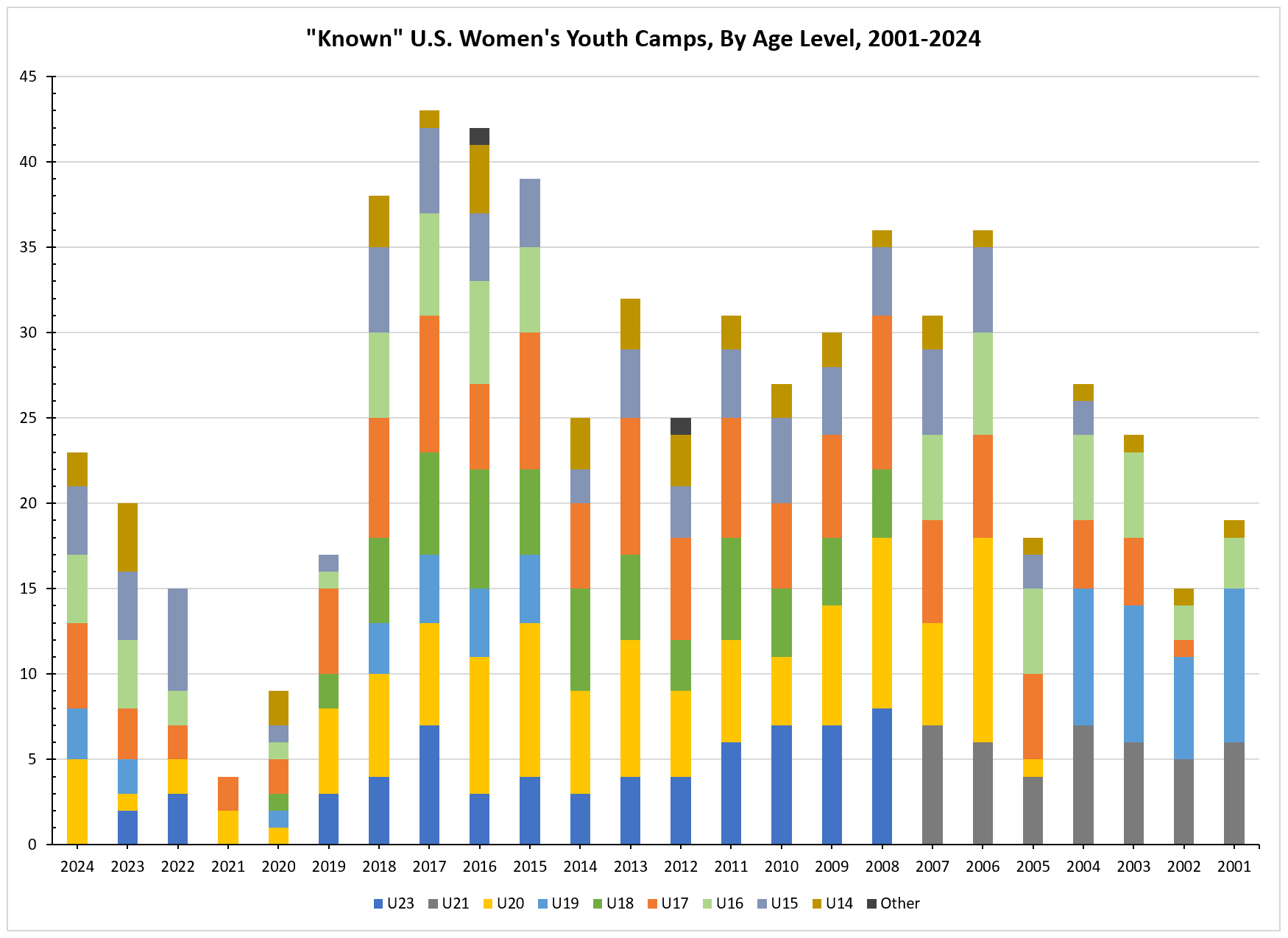
The first stated purpose of “doubl[ing] the number of” women’s youth “national team camps” from their current level is noteworthy because the number of WYNT camps held in 2024 is about half the number of camps compared to several years ago.
For more background on Kang’s pledged gift, in The Athletic, Meg Linehan has a good feature on Michele Kang and details on how the pledged gift came to be. (non-paywalled Yahoo version)
Announced Purposes of Kang’s Pledged Gift
U.S. Soccer’s press release is not clear on a few points, so quotes from the press conference have also been included to provide additional details. For example, the press release combines the number of female coaches and referees into a single total, but in the press conference, the number of coaches and referees were stated separately.
All of the below quotes from the press conference were stated by Michele Kang during her prepared remarks.
1. “Double the Number” of WYNT Camps
From the press release:
will allow U.S. Soccer to double the number of National Team camps it currently runs, equating to six camps per age group for Youth National Teams
From the press conference (10:35 mark):
double the number of national team camps for girls and women, bringing us to six camps per age group, which is a critical step to matching international standards
The math behind the above statement was not explained in either the press release or the press conference announcing Kang’s gift, so it is unclear how exactly this will expand the number of camps for specific age-level women’s youth national teams. For example, the Under-18 WYNT has been effectively inactive since 2020. Also, the USA’s Under-23 WYNT has not held any camps in 2024, which is in sharp contrast to its European counterparts, such as England, Spain, France, and Sweden, who play competitive matches in an unofficial league format during international windows (EnglandFootball.com).
The Math
Currently, the U.S. Soccer website lists seven age-levels designated as a “Women’s Youth National Team”: U-15, U-16, U-17, U-18, U-19, U-20, and U-23. However, the 2024 USWNT Media Guide states that “the U-18s & U-19s are combined now” (page 178).
“[S]ix camps per age group” would equate to a total of 36 camps per year, if the U-19 and U-18 levels remain combined, or 42 camps, if those age levels are separated again.
As of November 2024, U.S. Soccer has held 21 standalone (i.e., not directly connected to a competitive FIFA or Concacaf tournament) WYNT camps, plus at least two U-14 identification camps. (For the U-14 camps, U.S. Soccer has two published rosters on its website, which are described as the “first” and “second” camps of the year, but the 2024 USWNT Media Guide lists four expected camps.)
Doubling the number of WYNT camps would mean at least 42 camps per year, which matches the seven age-level system (i.e. U-19 and U-18 as separate teams).
The History
Kang’s comment about “matching international standards” is interesting because U.S. Soccer used to hold a significantly higher number of women’s youth camps. From 2015 to 2018, U.S. Soccer averaged about 40 standalone camps per year, including at the U-14 level. (In 2018, U.S. Soccer sent a U-14 to the Concacaf Girls’ Under-15 Championship.) During those years, U.S. Soccer had a full complement of seven women’s youth teams (U-15 through U-20, plus U-23).
In 2019, the number of known* women’s youth camps dropped by over half for unspecified reasons. The most charitable explanation is a change in priorities, especially given the greater emphasis on talent identification before the youth national team stage. (See page 179 of the USWNT Media Guide and the Talent Identification section of the U.S. Soccer website.) Following the COVID-19 lockdown, the number of known camps was only about 15 per year in 2022 and 2023.
*U.S. Soccer does not provide annual counts of youth national team camps. These numbers are based on my on-going research of WYNT rosters. In most cases a “known” camp has an official roster release by U.S. Soccer. Sometimes that does not happen, but concrete evidence of a camp can come from other sources: E.g. via a match report by another football association, information from a media guide, or a social media posting by a called-up player. Also, it is possible (if not somewhat likely) that, for whatever reason, I may have either missed a published camp roster or not properly indexed a camp roster.
The below chart shows the number of women’s youth camps, per year, by listed age-level, since 2001, which is the year before the first FIFA women’s youth tournament was held. Historically, U.S. Soccer’s listed age level for a team does not always line-up with that team’s birth year(s) pool. A table of the annual counts per age-level is provided after the chart.

Quick Thoughts
Increasing the number of youth camps and the emphasis on those camps is definitely welcomed as that should improve the quality of the youth national teams and should provide additional benefits to the women’s soccer ecosystem in the United States.
More time together in camps, along with additional youth international friendlies, should help competitive WYNTs, such as the U-20s and U-17s, perform better during Concacaf and FIFA tournaments. While winning a FIFA youth Women’s World Cup is nice, having players that are more prepared, and thus are less likely to make mistakes, greatly improves the utility of those youth WWC matches.
Having an active U-23 WYNT should be a priority. While it may be difficult to emulate the European unofficial league model in Concacaf, it should be possible to organize U-23 friendlies during international windows against Canada, Mexico, and one or two others, such as Brazil and/or Japan.
2. Digital Talent Identification Platform
help build out U.S. Soccer’s digital talent identification platform, bringing 12 times the number of players into the Youth National Team pipeline, giving access to 100,000 female players.
From the press conference (10:58 mark):
growing twelve-fold to reach 100,000 players, from 9,000 today
Either the math for the number of players involves some significant (if not creative) rounding or whoever drafted the public summary should have added “over” before the “100,000 female players”.
If the goal number is 100,000 then the current number of tracked players could be as low as about 83,000. If 9,000 is an accurate estimate of the current number of tracked players, then 12 times that would be about 108,000 .
3. Professional Development Opportunities for Female Coaches and Referees
The generous gift will also provide more professional development opportunities, including education and mentorship, to an additional 70,000 female coaches and referees, doubling the number of female coaches and referees in the game.
From the press conference (11:25 mark):
increase licensed female coaches from 40,000 to 80,000 and female referees from about 30,000 to 60,000
Of the three purposes, this one is the most nebulous in terms of how the money will be spent. Even if all of the pledged $30 million was allocated just on new coaches and referees, that would equate to about $425 per new coach/referee.
U.S. Soccer press release: “Businesswoman and Sports Owner Michele Kang Makes Historic Investment in U.S. Soccer and Women’s Sports” (19-Nov-2024)
 Women's Soccer Express