FIFA WWC: The 2031 FIFA Women’s World Cup will have 48 teams

On Friday, May 9, FIFA announced that the 2031 Women’s World Cup — which will most likely be hosted by the United States of America, plus other Concacaf nations — will have a field of 48 teams. That is an increase of 50% compared to its present size of 32. The decision was made by the FIFA Council (fifa.com).

The idea of expanding the Women’s World Cup to 32 teams had been discussed seriously by those within the FIFA Council since at least September 2024.

As to what a 48-team Women’s World Cup would look like, see this article from September 2024. That article includes a section on the potential field of teams as well as the potential pots for the draw that would determine the groups.


FIFA press release: “FIFA Council takes landmark decisions on the future of the FIFA Women’s World Cup™ and on the fight against racism” (9-May-2025)

U.S. Soccer press release: “U.S. Soccer and Concacaf Partners to co-host 2031 FIFA Women’s World Cup” (3-Apr-2025)
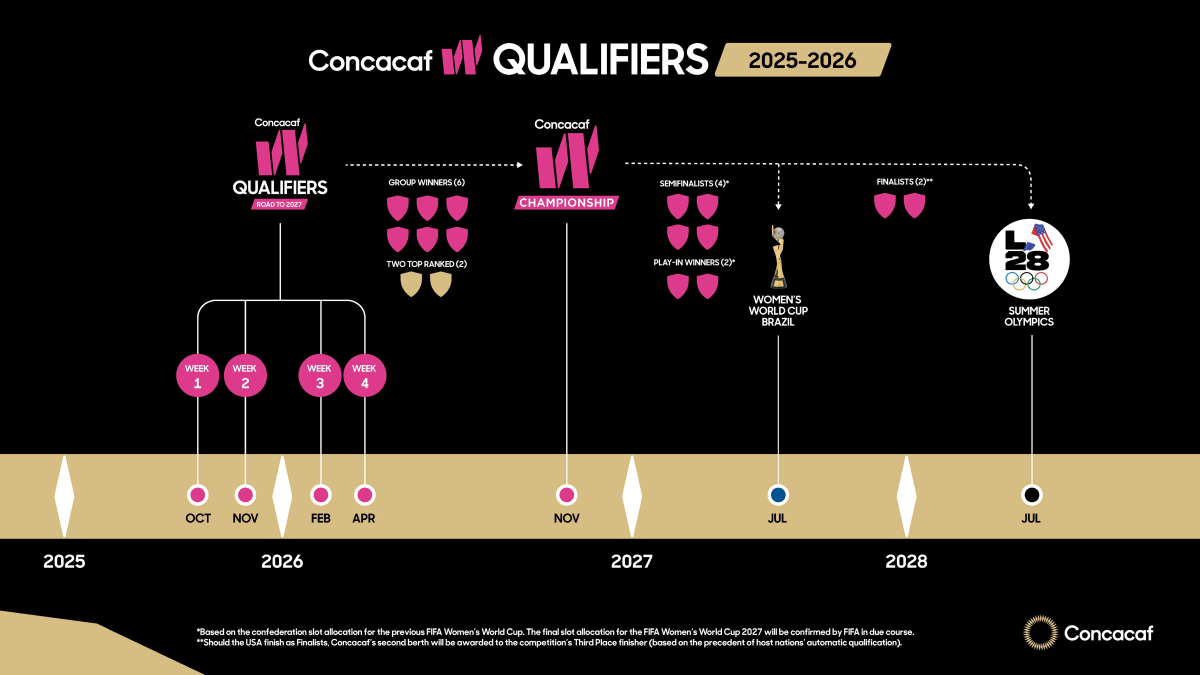
Concacaf takes step backward with qualifying format for the 2027 Women’s World Cup and 2028 Olympics

In mid-September, Concacaf published their plans for how women’s national teams in the region will qualify for the next FIFA Women’s World Cup and Summer Olympics. Instead of a traditional tournament with round-robin groups and a knockout phase, the final phase of qualifying will consist only of a knockout competition for the eight qualified teams. The four losing teams from the opening quarterfinals will then compete for Concacaf’s play-in spot(s).

The format change means that for the final eight teams, just one game will decide whether each gets an automatic slot into the 2027 FIFA Women’s World Cup, which will be hosted by Brazil. A single loss in the quarterfinal stage also means elimination from qualifying for the 2028 Los Angeles Olympics.

The two highest-ranked teams in Concacaf, which will almost certainly be the United States and Canada, will have direct entry to the quarterfinal stage, so those two teams will only need to win a single match in order to qualify for the 2027 WWC. This is ridiculously lower than the minimum number of matches that the highest-ranked teams in Concacaf have traditionally been required to play. It is also embarrassingly lower than the number of qualifying matches that top teams in other confederations are required to play in order to earn a WWC slot.

Additionally, the simplified format reduces the likelihood that the best teams from Concacaf will qualify for the next WWC and Olympics. Although a loss in the quarterfinals does not eliminate a team from qualifying for the WWC, the best team(s) from the repechage have the additional burden of competing in an inter-confederation play-in tournament, which could see them face competitive teams from Europe and Asia.

Continue reading “Concacaf takes step backward with qualifying format for the 2027 Women’s World Cup and 2028 Olympics”

A 48-Team FIFA Women’s World Cup in 2031?

Update (9-May-2025): The 2031 FIFA WWC will have a field of 48-teams.

On Tuesday, two separate articles were published by British media about a push for FIFA to expand the final tournament of the 2031 FIFA Women’s World Cup to 48 teams, which would match the size of the next men’s World Cup in 2026 .

Absent a change in format, the expansion to 48 teams would introduce an additional knockout round, the Round of Thirty-Two, extend the length of the tournament by several days, and increase the number of matches from 64 (48 group, 16 knockout) to 104 (72 group, 32 knockout). (2026 men’s World Cup – Wikipedia) The expansion may also mean an increase in the roster size for each team.

Read on for the key quotes from each article, plus a discussion of the allocations by confederation for recent Women’s World Cups as well as a potential allocation scenario for a generic 48-team Women’s World Cup. For this specific scenario, a table of the potential pots is also presented.

Additionally, an alternative tournament format is discussed, which would preserve a traditional 32-team format for the final tournament but introduce an intermediate inter-confederation group stage.

Continue reading “A 48-Team FIFA Women’s World Cup in 2031?”

2014 CONCACAF Women’s World Cup Qualifying TV Schedule

CONCACAF’s qualification tournament for the 2015 Women’s World Cup, the 2014 CONCACAF Women’s Championship (official website), kicks off today (Wednesday, October 15th), with all matches being shown live on the FOX Sports networks.  In addition to the live airings, FOX Sports will also have  a substantial number of re-airings for these matches available.   The full schedule of live matches and all listed re-airs are included below. Continue reading “2014 CONCACAF Women’s World Cup Qualifying TV Schedule”

FIFA Women’s International Match Calendars For 2013 and 2014

Last week, FIFA posted a circular (#1330) online detailing its official calendars for women’s matches in 2013 and 2014. These calendars list the reserved date windows when club teams are required to release their players for international friendlies, official qualifying matches, and finals tournaments. Continue reading “FIFA Women’s International Match Calendars For 2013 and 2014”

Slot Allocations for the 2015 Women’s World Cup and 2014 Youth WWCs Announced

Today or yesterday, FIFA uploaded a circular (PDF) with the details of the slot allocations per confederation for the 2015 Women’s World Cup, the 2014 Under-17 Women’s World Cup, and the 2014 Under-20 Women’s World Cup.

As the 2015 WWC will be the first with 24 teams, up from 16 teams, that allocation decision was of extra interest. CONCACAF had the biggest relative gain, going from 2.5 slots up to 4.5 slots (including host Canada), which means that the USA should have a lot less trouble qualifying this time around. Continue reading “Slot Allocations for the 2015 Women’s World Cup and 2014 Youth WWCs Announced”

The Dreaded 6-6-6-0 Round-Robin Group Scenario

In a four-team single round-robin schedule, a team that wins its first two matches is not guaranteed a top-two spot in the group under the rules typically used by FIFA and CONCACAF. There is a scenario where three teams in a group can win two matches each and lose a match each, resulting in the points being 6-6-6-0. Continue reading “The Dreaded 6-6-6-0 Round-Robin Group Scenario”